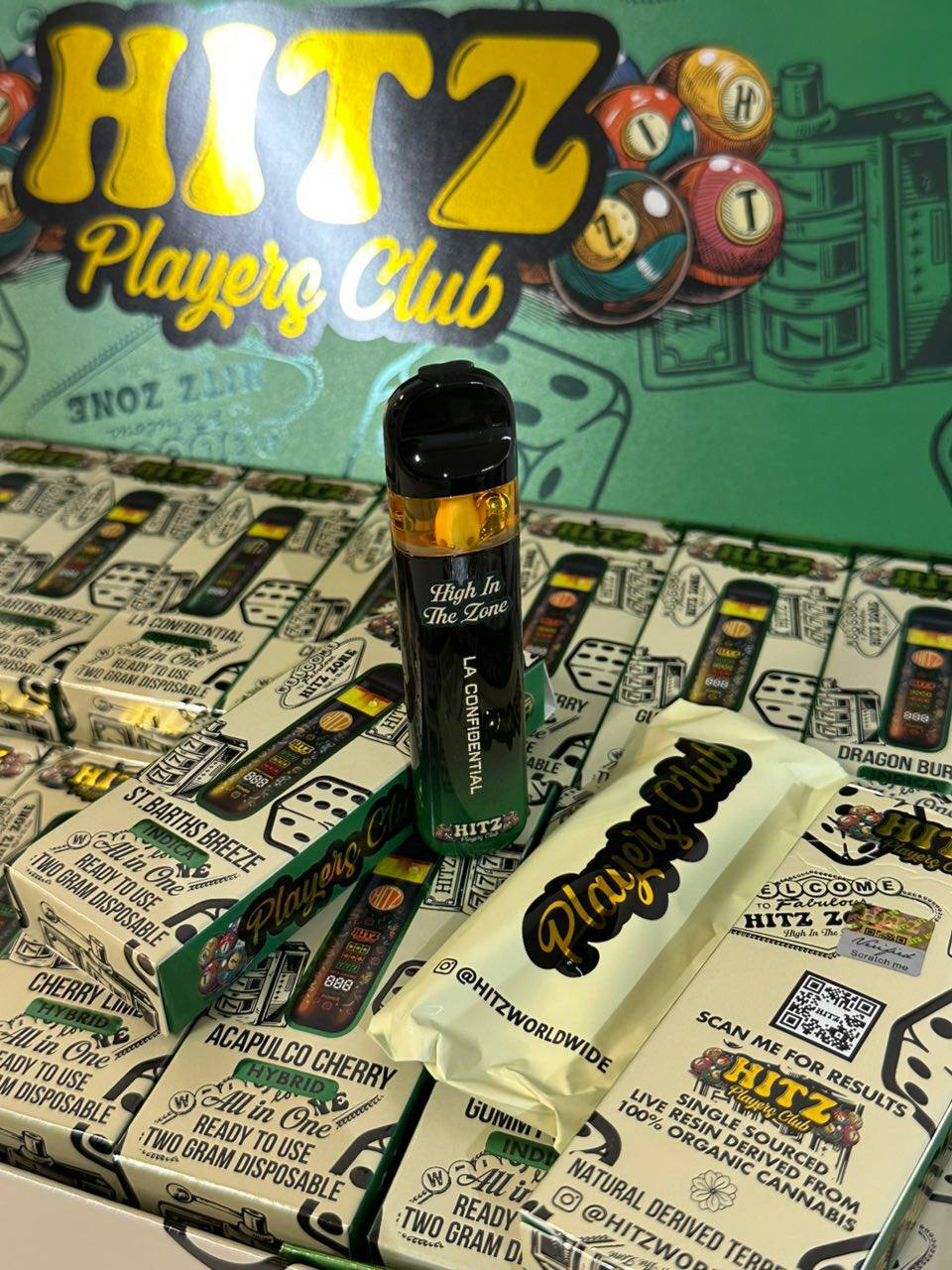
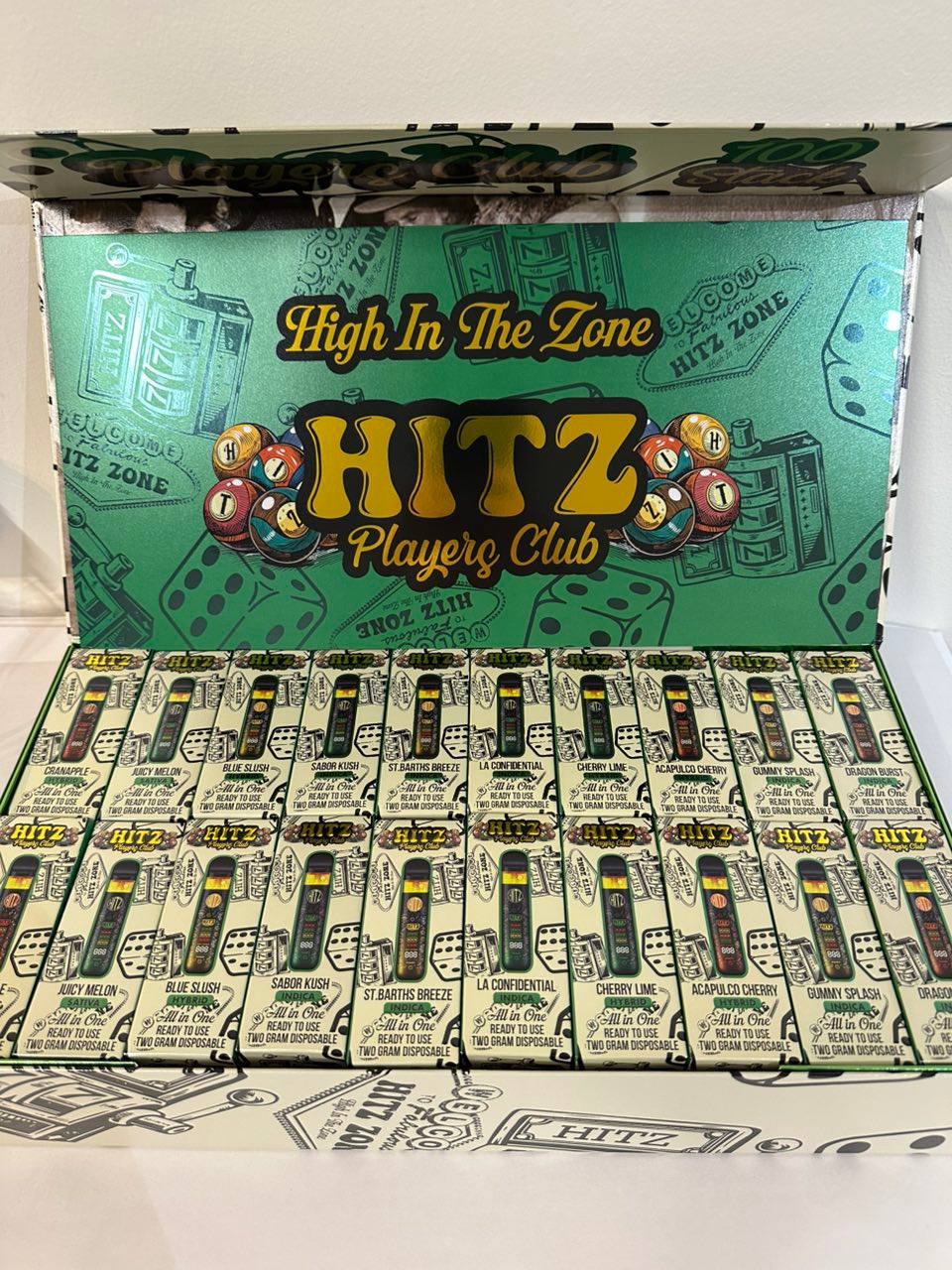
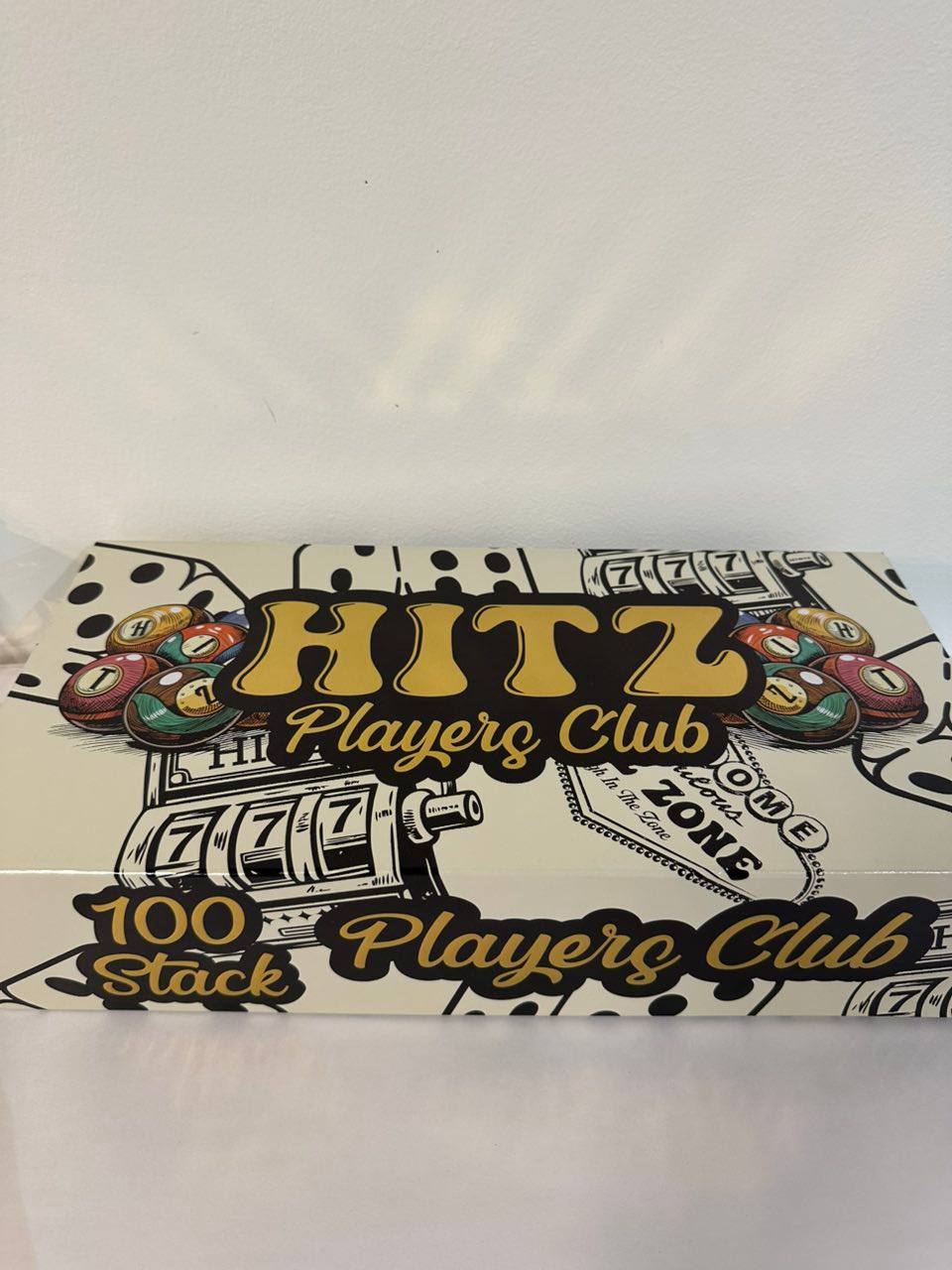
Hitz Players Club 2G Disposable
Product Overview
The Hitz Players Club 2G Disposable is a compact disposable vaping product presented in a portable format. Its design combines a small body with an integrated battery and pre-filled chamber, creating an all-in-one format that does not require a separate device. The product name is associated with the Players Club line, while the 2G designation refers to the stated amount of material contained in the device.
Because disposable products can vary by market, batch, and manufacturer, product details should be checked against the packaging and the manufacturer’s current information. Specifications shown on a particular package may differ from descriptions found elsewhere online. Therefore, packaging remains the most appropriate source for confirming ingredients, cannabinoid content, batch information, and other product-specific details.
Design and Build
The compact construction is one of the defining characteristics of a disposable device. Instead of separating the battery, cartridge, and mouthpiece into multiple components, the essential parts are contained within one unit. As a result, the overall form remains relatively simple and portable.
The exterior typically serves both a functional and visual purpose. Its shape allows the device to fit into a pocket or small personal bag, while the printed presentation provides information about the product line. Depending on the specific release, the appearance, graphics, and labeling may differ.
The integrated format also means that the device is generally supplied as a complete unit rather than as a refillable system. Once the contents or battery are depleted, the device reaches the end of its intended service life. It is therefore different from a reusable vaporizer that can be refilled or fitted with a replacement cartridge.
Understanding the 2G Format
The term “2G” refers to the stated quantity of material contained in the device. It does not necessarily indicate the amount of a particular cannabinoid. The actual cannabinoid concentration, ingredients, and formulation are determined by the product specification and labeling.
This distinction is important because two products with the same stated quantity can have very different formulations. Potency information, laboratory results, ingredient lists, and batch details provide more meaningful information about the contents than the 2G designation alone.
Product labeling can also provide information about the manufacturer, lot number, testing information, warnings, and other regulatory details. Those details can vary depending on where the product is distributed.
Disposable Construction
A disposable vaporizer generally contains several integrated components. The main elements include a battery, heating element, reservoir or chamber, airflow pathway, and mouthpiece. These components work together within the exterior housing.
The battery supplies electrical energy to the heating element. When activated, the heating element produces heat that converts the material in the reservoir into an inhalable aerosol. The aerosol then travels through the internal airflow pathway toward the mouthpiece.
Since these components are enclosed within the device, the user does not normally interact directly with the internal hardware. This differs from open systems in which individual components can be removed, replaced, or maintained.
The enclosed design also limits maintenance options. Once a disposable unit reaches the end of its usable life, replacement of the complete device is generally more practical than attempting to service individual components.
Portability and Convenience
The small form factor is an important characteristic of disposable vaping devices. A self-contained design removes the need for a separate battery or cartridge, while the integrated construction reduces the number of individual components.
Portability, however, does not remove the importance of appropriate storage. Temperature, moisture, direct sunlight, and physical pressure can affect electronic devices and their contents. Packaging information should therefore be considered when determining suitable storage conditions.
The device should also remain inaccessible to children and animals. Products containing cannabinoids or other active ingredients can present significant risks when consumed unintentionally.
Flavor and Formulation Information
Flavor names and formulation details can vary across versions of a product. A product listing should therefore rely on the information printed on the specific package rather than assuming that every release contains the same formulation.
Descriptions such as fruity, sweet, tropical, creamy, or earthy are often used in vaping-product marketing, but these terms do not establish the actual chemical composition of a formulation. Ingredients and laboratory documentation provide more reliable information.
Terpenes may also contribute to the aroma and flavor profile of cannabis-derived formulations. However, the presence and concentration of individual terpenes should be confirmed through product documentation rather than inferred from a flavor name.
Cannabinoid Content
Cannabinoid content is another specification that requires attention to the individual product label. Cannabis-derived products may contain cannabinoids such as THC, CBD, CBG, or other compounds, depending on the formulation and jurisdiction.
The concentration of these compounds can influence the effects associated with the product. For that reason, a product description should not assume a particular potency when the relevant laboratory information has not been verified.
The stated 2G quantity also should not be interpreted as a 2G amount of THC. These are separate measurements. The total material weight and cannabinoid concentration describe different aspects of a formulation.
Packaging and Label Information
Packaging is an important source of product information. Depending on the jurisdiction, labeling may include the product name, cannabinoid concentrations, net contents, ingredients, batch or lot number, manufacturing information, testing details, warnings, and regulatory symbols.
A legitimate product should have labeling appropriate to the market in which it is sold. However, packaging appearance alone cannot establish authenticity.
Online descriptions can also become outdated when manufacturers change packaging or release new versions. Consequently, the information printed on the current package has greater value when confirming specific details.
Laboratory Testing
Laboratory testing can provide information about the composition and quality of a cannabinoid product. A certificate of analysis, where available, may contain measurements for cannabinoids, contaminants, pesticides, residual solvents, heavy metals, microbial contamination, or other parameters.
Testing information should correspond to the relevant batch whenever possible. A generic laboratory report that cannot be connected to the specific product or batch provides less useful evidence.
Independent verification is particularly relevant for products purchased outside regulated markets. Counterfeit or improperly labeled products can resemble legitimate products while containing different substances or concentrations.
Authenticity Considerations
The popularity of recognizable vaping brands has created an environment in which imitation packaging can appear online and in physical markets. Product appearance alone is therefore not a reliable authenticity test.
Packaging inconsistencies, spelling errors, unusual printing quality, missing batch information, broken seals, or inconsistent labeling can be reasons for additional caution. Manufacturer verification systems, where available, can provide another source of information.
Authenticity information should be obtained directly from the manufacturer or an authorized regulatory source rather than relying exclusively on third-party product listings.
Battery and Hardware
The integrated battery is a central part of the disposable design. It provides the electrical energy required by the heating element, allowing the device to function without an external power source during normal use.
Electronic components can be affected by extreme temperatures, moisture, impact, or physical damage. A damaged device may not function normally, and attempts to open or modify the housing can introduce additional risks.
Disposable electronics should therefore be treated differently from ordinary non-electronic packaging. Local rules may determine the appropriate method for disposal, particularly where batteries are involved.
Storage Considerations
Storage conditions can affect both electronic hardware and the material contained within a disposable device. Excessive heat may affect battery performance and product stability, while excessive moisture can damage electronic components.
Direct sunlight can also expose the device to elevated temperatures. Physical pressure or impact may damage the housing or internal components.
A cool, dry environment away from children and animals is generally more appropriate for products of this type than an area exposed to heat, sunlight, or moisture. The manufacturer’s storage instructions remain the primary reference for product-specific requirements.
Responsible Product Information
Cannabis-derived vaping products can contain psychoactive cannabinoids. Products containing THC may affect perception, coordination, reaction time, memory, and judgment.
For that reason, information about a product should not be interpreted as a recommendation for use. Individual responses can vary considerably depending on cannabinoid concentration, personal factors, previous exposure, and other circumstances.
People who are unfamiliar with cannabis products may experience stronger or different effects than expected. Interactions with alcohol, medications, or other substances may also create additional concerns.
Driving or operating machinery after consuming an intoxicating cannabis product can create serious safety risks. Local laws may also restrict possession, use, transport, or distribution.
Age and Legal Considerations
Cannabis laws differ significantly between countries, states, provinces, and municipalities. Age requirements, possession limits, product categories, and permitted forms of cannabis can all vary.
A product that is legal in one jurisdiction may be prohibited in another. Cross-border transportation can introduce additional legal issues as well.
Consequently, legal status should always be determined according to the regulations applicable to the location where the product is possessed or used. Product descriptions cannot substitute for current legal guidance.
Disposable Products and Waste
Because the battery and other components are integrated into the device, a disposable vaporizer creates electronic waste when it reaches the end of its service life. The appropriate disposal method depends on local waste-management regulations.
Devices containing batteries should not automatically be treated as ordinary household waste. Some communities provide dedicated collection points for batteries or electronic devices.
The exterior packaging may also contain recyclable materials, although recycling availability varies by location. Local recycling guidance provides the most accurate information about available disposal options.
Product Identification
Several details can help distinguish one version of a disposable product from another. These may include the printed product name, stated quantity, flavor or formulation designation, batch number, package design, manufacturer information, and laboratory documentation.
These identifiers are especially useful because product lines can contain multiple versions. Similar packaging does not necessarily mean identical contents.
The most reliable identification process compares several details rather than relying on a single visual feature.
Why Product Specifications Matter
Specifications give consumers a clearer understanding of what a product contains and how it is constructed. Quantity, cannabinoid concentration, ingredients, testing information, hardware specifications, and packaging details each provide different information.
For example, a 2G designation communicates the stated quantity, while a laboratory result may communicate cannabinoid percentages. Neither measurement alone provides a complete picture.
Clear product information is therefore most useful when it separates physical specifications from chemical composition and avoids unsupported assumptions.
Common Questions About the Product
What does 2G mean?
The 2G designation generally refers to the stated quantity of material contained in the disposable device. It does not automatically mean that the device contains 2 grams of THC or another individual cannabinoid.
Is it refillable?
A disposable device is generally designed as a self-contained product rather than a refillable system. The exact construction should be confirmed through the manufacturer’s documentation for the specific version.
Does every version have the same formulation?
Not necessarily. Formulations, flavors, packaging, and cannabinoid concentrations can vary between releases or markets. The individual package provides the most relevant information.
How can authenticity be evaluated?
Authenticity can be assessed through manufacturer information, packaging details, batch identifiers, applicable verification systems, and laboratory documentation where available. Visual appearance alone is insufficient.
How should the device be stored?
Storage requirements depend on the manufacturer’s specifications. In general, protection from excessive heat, moisture, sunlight, children, animals, and physical damage is relevant for electronic cannabinoid products.
What happens when the device is depleted?
A disposable device is intended to reach the end of its service life once its contents or battery are depleted. Disposal should follow applicable local rules for electronic devices and batteries.
Product Experience and Expectations
The experience associated with a cannabinoid disposable can vary from person to person. Factors such as cannabinoid concentration, formulation, individual tolerance, previous exposure, and biological differences can influence the response.
For that reason, broad claims about effects should not be treated as universal. A description of a product’s physical characteristics can be more reliable than promises about how every individual will feel.
Flavor perception can also differ between users. Terpene composition, formulation, temperature, and individual sensory differences can all influence the perceived aroma and taste.
Quality Information
Quality assessment involves more than appearance. Manufacturing consistency, accurate labeling, laboratory testing, packaging integrity, and traceability all contribute to a clearer understanding of a cannabinoid product.
A professionally presented package does not by itself establish laboratory quality. Conversely, a minor packaging variation does not automatically prove that a product is counterfeit.
Reliable documentation remains the stronger basis for evaluating composition and authenticity.
A Closer Look at the All-in-One Format
The all-in-one design combines the principal components within one housing. This arrangement reduces the number of external parts and gives the product its characteristic disposable form.
The reservoir holds the formulation, while the heating element provides the heat required for aerosol production. Airflow channels connect the internal components with the mouthpiece.
Because these elements are integrated, there is less opportunity for conventional maintenance than with reusable vaporizer systems. The trade-off is a simpler external design combined with a shorter overall product lifecycle.
Packaging Transparency
Transparent product information can make it easier to understand what is being offered. Clear labeling should distinguish net contents from cannabinoid concentration and should provide relevant manufacturing or testing information where required.
This distinction is particularly important for online product pages. A product title can communicate identification, but detailed specifications should come from verifiable documentation.
Where information cannot be confirmed, it is more accurate to identify it as unverified than to fill the gap with assumptions.
The Hitz Players Club 2G Disposable is a compact, integrated vaping product identified by its Players Club branding and stated 2G capacity. Its disposable construction combines the battery, heating hardware, reservoir, airflow system, and mouthpiece into a single unit.
The 2G designation describes the stated quantity rather than automatically indicating cannabinoid potency. Actual composition depends on the specific formulation and should be confirmed through current packaging and, where available, corresponding laboratory documentation.
Product versions can differ by flavor, formulation, packaging, market, and release. Therefore, current manufacturer information remains more reliable than generalized descriptions.
From a technical perspective, the disposable format emphasizes portability and an integrated design. At the same time, the enclosed construction means that the device is not equivalent to a reusable vaporizer with replaceable components.
Storage, authenticity, laboratory information, age restrictions, local laws, and responsible handling are all relevant when evaluating a cannabinoid-containing disposable product. Electronic waste considerations also apply because the device contains an integrated battery.
Overall, the most useful product information is information that clearly separates verified specifications from assumptions. Quantity, ingredients, cannabinoid concentrations, testing results, packaging identifiers, and manufacturer details each provide a different part of the product profile. Together, these details offer a more complete and accurate understanding of the Hitz Players Club 2G Disposable without relying on unsupported claims.
Hitz Players Club 2G Disposable: Additional Product Information
Product Construction and Internal Components
The Hitz Players Club 2G Disposable uses an integrated structure in which the primary operating components are housed within one compact device. This construction is common among disposable vaporizer products because it reduces the number of separate parts required for operation.
The internal system generally consists of a battery, heating element, reservoir, airflow pathway, and mouthpiece. Each component has a specific function within the overall design. The battery provides electrical power, while the heating element converts that electrical energy into heat. The reservoir contains the product formulation, and the airflow pathway allows the resulting aerosol to travel toward the mouthpiece.
Because the components are enclosed, the external appearance provides limited information about the internal hardware. Consequently, technical specifications should be obtained from manufacturer documentation rather than inferred from the shape or size of the device.
Reservoir Capacity
The stated 2G capacity identifies the amount of material associated with the product. However, capacity should not be confused with cannabinoid potency.
For example, a product containing 2 grams of formulation could have a different cannabinoid concentration from another product containing the same quantity. The total weight describes the amount of formulation, while laboratory testing can provide information about the concentration of individual compounds.
This distinction is useful when comparing products because quantity alone does not establish strength, composition, or expected effects.
Heating Technology
The heating element is responsible for transforming the formulation into an aerosol. When the device is activated, electrical energy passes through the heating system, generating heat within the designated chamber.
The precise heating technology can differ between manufacturers and product generations. Some devices use different coil constructions, airflow arrangements, or activation systems. Therefore, specific technical claims should only be made when they are supported by documentation for the particular product version.
A consistent heating system can influence aerosol production and flavor perception, although individual experiences may vary.
Airflow Design
Airflow is another important part of disposable vaporizer construction. Air must travel through the device before reaching the mouthpiece, and the internal pathway influences how the aerosol moves through the unit.
The resistance experienced during inhalation can depend on the airflow design, openings, heating element, and other internal characteristics.
External inspection may reveal certain airflow openings, but it does not necessarily reveal the complete internal pathway. Manufacturer specifications remain the more reliable source for technical details.
Mouthpiece Design
The mouthpiece forms the final section of the airflow pathway. Its primary function is to provide an interface between the device and the user while directing aerosol from the internal system.
Dimensions and shape can vary between product versions. Some designs use a narrow mouthpiece, while others incorporate a wider opening. These differences can influence the physical feel of the device but do not independently establish product quality or cannabinoid composition.
Keeping the mouthpiece protected from contamination is also relevant because it comes into direct contact with the user.
Exterior Presentation
Brand presentation plays a noticeable role in disposable products. The exterior housing may feature logos, graphics, product names, edition information, and other visual identifiers.
The printed design can change when a manufacturer introduces updated packaging or new editions. Therefore, online photographs should not automatically be treated as evidence that every current unit will have identical artwork.
Packaging changes can occur without corresponding changes to the underlying product specifications. For that reason, product identification is best based on multiple details.
Batch Information
Batch or lot information can provide an important connection between a physical product and its manufacturing records. Where laboratory testing is available, the batch identifier may help determine whether a particular certificate of analysis corresponds to the product being examined.
A batch number should not be interpreted as proof of quality by itself. Instead, it serves as one element within a broader traceability system.
The location and format of batch information can vary according to packaging design and regulatory requirements.
Certificates of Analysis
A certificate of analysis, commonly abbreviated as COA, may provide laboratory measurements associated with a cannabinoid product. Depending on the testing laboratory and jurisdiction, the document can include cannabinoid concentrations and screening for various contaminants.
A useful COA should contain enough identifying information to establish its connection to the relevant product or batch. A document without clear product identification provides less certainty.
Laboratory results can also have expiration or reporting dates. Therefore, older documents may not accurately represent a newer manufacturing batch.
Cannabinoid Profiles
Cannabinoid profiles can differ considerably among formulations. THC is one of the best-known cannabinoids, while CBD, CBG, and other cannabinoids may appear in some formulations.
The presence and concentration of these compounds should be established through laboratory information or verified labeling. Product names and flavor descriptions do not provide sufficient evidence for determining cannabinoid composition.
Cannabinoid content can also vary between batches if manufacturing specifications change. Consequently, batch-specific information can be particularly useful when precise composition matters.
Terpenes and Aromatic Compounds
Terpenes are naturally occurring aromatic compounds found in cannabis and numerous other plants. They can contribute to aroma and flavor characteristics.
Names used for flavor or strain-style descriptions may reference familiar terpene profiles. However, a product name does not necessarily establish the exact terpene composition.
When terpene information is important, laboratory documentation or a manufacturer’s ingredient information provides a more reliable reference.
Product Consistency
Consistency is an important consideration when evaluating manufactured products. Factors such as filling accuracy, battery performance, heating behavior, labeling, and packaging can contribute to the overall consistency of a product line.
However, consistency cannot be determined from a single unit alone. A broader assessment would require information from multiple production batches and appropriate testing.
For this reason, claims about uniform performance across every unit should be treated cautiously unless supported by manufacturer or laboratory evidence.
Device Longevity
The useful life of a disposable device depends on multiple factors. The quantity of formulation is one consideration, while battery capacity, heating efficiency, activation frequency, and other technical characteristics can also affect how long the device remains functional.
The stated 2G capacity should therefore not be converted into a guaranteed number of sessions, draws, or days of use. Actual performance can vary.
Battery depletion can also occur before all of the material has been consumed, depending on the particular hardware and operating conditions.
Battery Considerations
An integrated battery makes the disposable format self-contained, but it also means that the device contains electronic components that require appropriate handling.
Visible swelling, severe physical damage, unusual heat, leakage, or other signs of battery failure should be treated as reasons to discontinue handling the device and follow applicable disposal guidance.
The device should not be deliberately punctured, opened, crushed, or modified. Internal battery components can present hazards when damaged.
Environmental Considerations
Disposable electronics create waste because the complete device is discarded rather than maintained indefinitely. The presence of a battery means that specialized disposal requirements may apply.
Environmental handling varies by location. Some municipalities provide dedicated collection systems for batteries or electronic products, while others provide different disposal instructions.
Packaging components may have separate recycling requirements. As a result, the appropriate disposal method should be determined according to local waste-management guidance.
Product Storage Environment
Environmental conditions can influence both electronic components and cannabinoid formulations. High temperatures may affect batteries and stored materials, while moisture can interfere with electronic hardware.
Direct sunlight can also increase the temperature of the device, particularly when it is left inside an enclosed vehicle or near a window.
A stable environment away from excessive heat, moisture, and direct sunlight is generally more appropriate for electronic products. Manufacturer-specific storage instructions should take priority whenever they are available.
Child and Animal Safety
Cannabinoid-containing products should be kept away from children and animals. Accidental ingestion or exposure can result in serious consequences, particularly because the contents may contain psychoactive substances.
Packaging should remain secure when the product is not being handled. Storage locations should also reduce the likelihood of accidental access.
These considerations apply regardless of brand, flavor, formulation, or device size.
Label Accuracy
Accurate labeling allows consumers and regulators to identify important product characteristics. Depending on the applicable jurisdiction, labels may include net contents, cannabinoid concentrations, ingredients, warnings, manufacturer information, batch details, and other required information.
Labels should be evaluated together rather than relying on a single statement. For instance, the 2G designation describes quantity, while a THC percentage describes cannabinoid concentration.
This distinction prevents common misunderstandings when comparing disposable products.
Online Product Information
Online listings can provide useful descriptions, but they may not always reflect the latest packaging or formulation. Product pages can remain available after a manufacturer has updated a product, and photographs may represent earlier editions.
For this reason, online information should be compared with the current physical packaging whenever possible.
Unverified claims about potency, ingredients, laboratory testing, or hardware should not be treated as established specifications.
Recognizing Product Variations
Product lines can contain multiple versions that share similar branding. Differences may include formulation, flavor, hardware generation, packaging artwork, quantity, or market-specific labeling.
The Players Club name alone may therefore be insufficient to identify every specification associated with a particular unit.
A more complete identification process considers the product name, stated quantity, edition or version, packaging, batch number, manufacturer information, and available laboratory documentation.
Regulatory Differences
Cannabis and cannabinoid regulations vary widely. Some jurisdictions permit certain products under regulated systems, while others prohibit them entirely or impose restrictions on possession, manufacturing, sale, or consumption.
Vaping products may also be subject to separate requirements concerning labeling, packaging, age restrictions, and testing.
Therefore, information about a product should not be interpreted as confirmation that it is legal in a particular location. Current local regulations provide the appropriate basis for determining legal status.
Health and Safety Information
Cannabis products containing THC can produce psychoactive effects. Responses vary between individuals, and factors such as cannabinoid concentration, personal sensitivity, previous exposure, and other substances can influence those effects.
Some people may experience changes in coordination, attention, reaction time, memory, or perception.
Cannabis use can also interact with alcohol or certain medications. Individuals with questions about potential interactions should seek advice from an appropriately qualified healthcare professional.
No product description can predict an individual’s response with certainty.
Driving and Machinery
Psychoactive cannabis products can impair abilities that are important for driving and operating machinery. Reaction time, attention, coordination, and judgment can be affected.
Consequently, product information should not be interpreted as an indication that use is compatible with driving or other safety-sensitive activities.
Applicable laws may also impose penalties for driving while impaired, including laws that differ from those governing legal possession or consumption.
Product Information Without Assumptions
A reliable product description separates verified information from interpretation. Statements about capacity, construction, packaging, ingredients, and laboratory results should be based on identifiable sources.
Where information is unavailable, a neutral description can acknowledge that limitation rather than presenting an assumption as fact.
This approach is especially important for products that have multiple versions or whose specifications may change over time.
Comparison With Reusable Devices
Disposable devices and reusable vaporizers use similar broad principles but differ significantly in construction.
A disposable unit generally combines the battery, reservoir, heating system, and mouthpiece into a single product. A reusable system typically separates some of these components, allowing parts to be replaced or maintained.
The disposable format can reduce the number of separate components, whereas reusable systems can offer greater flexibility. Neither format should automatically be considered superior because suitability depends on the product design and the user’s circumstances.
Product Identification Checklist
Several details can be considered when documenting a Hitz Players Club 2G Disposable:
- Product name printed on the package
- Stated net quantity
- Formulation or flavor designation
- Cannabinoid information
- Ingredient information
- Batch or lot number
- Manufacturer information
- Laboratory documentation
- Packaging condition
- Applicable regulatory information
These details create a more complete product record than the product name alone.
Final Notes
The Hitz Players Club 2G Disposable represents a compact, integrated disposable vaporizer format identified by its Players Club branding and stated 2G capacity. Its construction places the primary operating components inside a single housing, including the battery, heating system, reservoir, airflow pathway, and mouthpiece.
The 2G designation should be understood as a quantity measurement rather than a direct measurement of cannabinoid potency. Actual composition depends on the formulation associated with the specific product and batch.
Packaging, laboratory documentation, and manufacturer information remain important when verifying specifications. Product versions may differ in appearance, formulation, hardware, and labeling, so generalized online descriptions should not replace current product documentation.
Responsible handling also includes appropriate storage, keeping the product away from children and animals, observing local laws, and following applicable electronic-waste requirements when the device reaches the end of its service life.
A clear product description works best when it provides factual information without making unsupported promises. For the Hitz Players Club 2G Disposable, the most useful details are its stated capacity, integrated construction, labeling, cannabinoid information, testing documentation, packaging identifiers, and applicable safety considerations.
Reviews
There are no reviews yet.